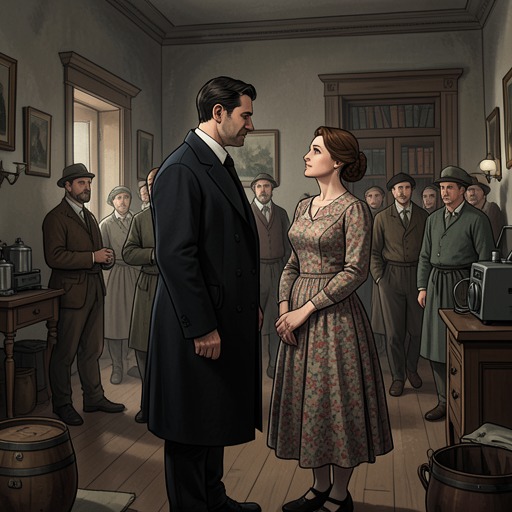
Ruth loses faith in Martin’s literary vocation
Martin EdenRuth Morse’s loss of faith in Martin Eden’s literary vocation becomes explicit in a conversation where love and artistic belief pull apart. She admires his poems, but cannot imagine them providing the livelihood their marriage requires; when he asks directly whether she believes he is meant to write, she says she does not. The rupture is not a declaration that she no longer loves him. It is the sharper conflict between her affection for Martin and her judgment that his chosen work cannot secure their future.
The Love-cycle and the practical question
On a beautiful fall afternoon, on the hill where they had declared their love the year before, Martin reads Ruth his “Love-cycle.” The setting recalls their beginning together, but the reading turns the anniversary-like encounter into a test of what their relationship can bear. Ruth interrupts with expressions of pleasure, and Martin waits for her judgment after putting away the last sheet. Her hesitation signals that praise will not be the answer he wants.
Ruth calls the poems beautiful, then asks whether they can be sold. She believes something in the writing—or perhaps in the market—keeps Martin from earning a living. Her concern is not simply that the poems fail to bring in money: the year since they acknowledged their love has passed without bringing their wedding any closer. She tells him that their marriage is at stake and proposes newspaper work, at least temporarily, as a practical alternative. Martin replies that reporting would spoil the style for which he has worked so hard. Their disagreement is therefore about more than a job. For Ruth, work must make a shared life possible; for Martin, the kind of work he accepts may damage the artistic purpose that gives his life direction.
Marriage, family opposition, and an offered alternative
Ruth has already taken a consequential step on Martin’s behalf. She has spoken to her father and mother, asserted herself against them, and repeatedly affirmed her lasting love for Martin. Her father, despite being opposed to him, has agreed that Martin may start immediately in his office and offered to pay him enough for the couple to marry and establish a small cottage. Ruth presents the offer as generous and hopes Martin will recognize its value.
But the offer carries the judgment beneath it. Ruth explains that her father dislikes Martin’s radical views and considers him lazy, even though she knows how hard he works. The possibility of a secure marriage thus depends on Martin entering a future arranged through the very family whose approval he lacks. When he asks whether her parents’ opinions disturb her, Ruth says they are disconcerting; the pressure of the exchange leaves him so oppressed that he forgets her tentative proposal of employment. His silence does not settle the question. It postpones it, while Ruth waits for him to respond.
The admission of lost faith
Within the week, Martin tests Ruth’s judgment by reading her The Shame of the Sun. She again recommends journalism, imagining a path through which his love of writing might lead to success, recognition, and a substantial salary. Her examples are eminent correspondents sent across the world, including to Africa or to interview the Pope. Martin hears this as a distinction between the writing she believes can succeed commercially and the literature he believes is his vocation. He asks whether she has lost faith in him, then narrows the question to faith in his writing.
Ruth first answers indirectly: other writers sell their work, while Martin does not. When pressed to say whether literature is not his vocation, she steels herself and answers plainly that she does not think he was made to write. She invokes her Bachelor of Arts and her greater knowledge of literature, making the judgment more than a worried guess about income. To Martin, it is a verdict on the capacity he believes he knows from within. The exchange converts her earlier practical advice into an explicit withdrawal of confidence in his artistic calling.
Martin’s counterclaim and the meaning of love
Martin does not accept Ruth’s assessment. He insists that he knows what he has in him, expects to succeed, and is burning to express himself in verse, fiction, and essays. Yet he says he is not asking her to believe in his writing or even in him: what he asks is that she love him and have faith in love. He recalls her earlier counsel that he must serve an apprenticeship, and claims to have compressed that apprenticeship through relentless work. His account makes visible the private cost behind his ambition: he uses an alarm clock to control his sleep, trades a heavy book for a lighter one when drowsiness comes, and beats his head with his knuckles to stay awake. He says that five and a half hours of sleep would be an extravagance and that he now sleeps four.
Ruth’s doubt therefore meets not casual aspiration but a vocation to which Martin has devoted his days and sacrificed rest. Their exchange exposes a painful mismatch in what each is being asked to trust: she wants evidence that writing can sustain a marriage, while he asks her to hold faith in their love without requiring confidence in his prospects. When he asks whether she still loves him, she answers that she does. Martin takes her declaration as a triumph over her family’s enmity and over the bleakness of the moment. But the distinction he draws cannot erase the wound: her love remains, while her belief that he is meant to write has failed. The scene makes that separation—between affection and faith in the vocation—central to the strain on their future together.